

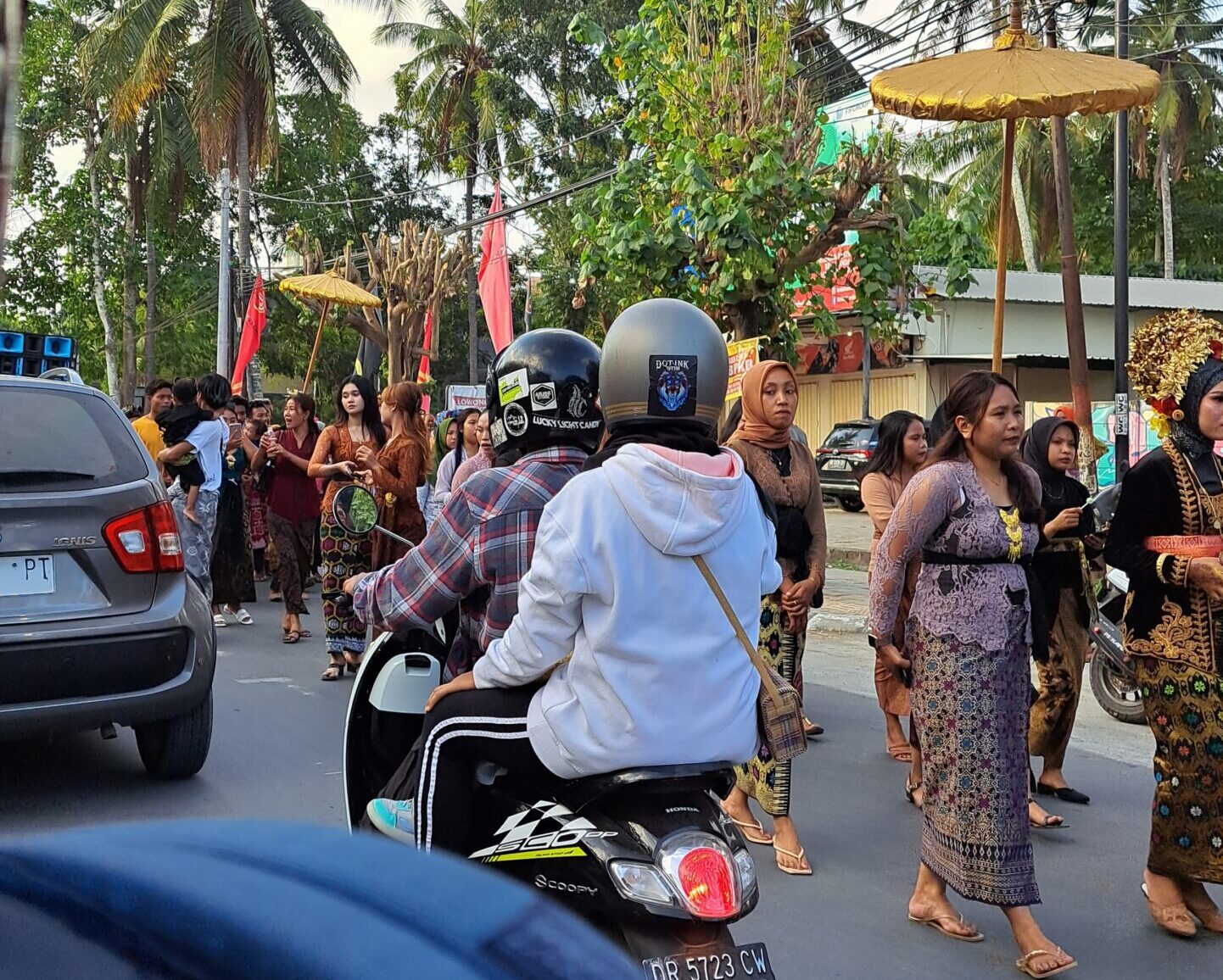
On certain days in Lombok, you may encounter an unusual sight: a long procession moving along the road, accompanied by music and surrounded by people dressed in traditional Sasak clothing. At its center are a newly married bride and groom.
This is Nyongkolan, one of the best-known wedding traditions of the Sasak people of Lombok.
What is Nyongkolan?
At its simplest, Nyongkolan is a procession that takes the newlyweds from the groom’s home to the bride’s family home. But it is more than a wedding celebration. The procession also serves as a public announcement that the couple is now married, while bringing together relatives, elders and members of the wider community.
Traditionally, the procession is filled with symbols. The bride and groom wear Sasak attire, while companions hold umbrellas over their heads as a sign of honor. A small garden, known as Kebun Kodeq, may also be carried in the procession, symbolizing the couple’s welfare and the sustainability of their future home. Traditionally, the procession is accompanied by gendang beleq, the large drums that have become strongly associated with Sasak cultural performances.
Researchers have interpreted these symbols as expressions of several important values. One study identifies three philosophical ideas behind Nyongkolan: Epe-Aik, referring to the relationship between humans and God; Gumi-Paer, concerning humans’ relationship with the earth and nature; and Budi-Kaye, emphasizing virtue, wisdom and good character.
But Nyongkolan is not frozen in the past.
Today’s Nyongkolan
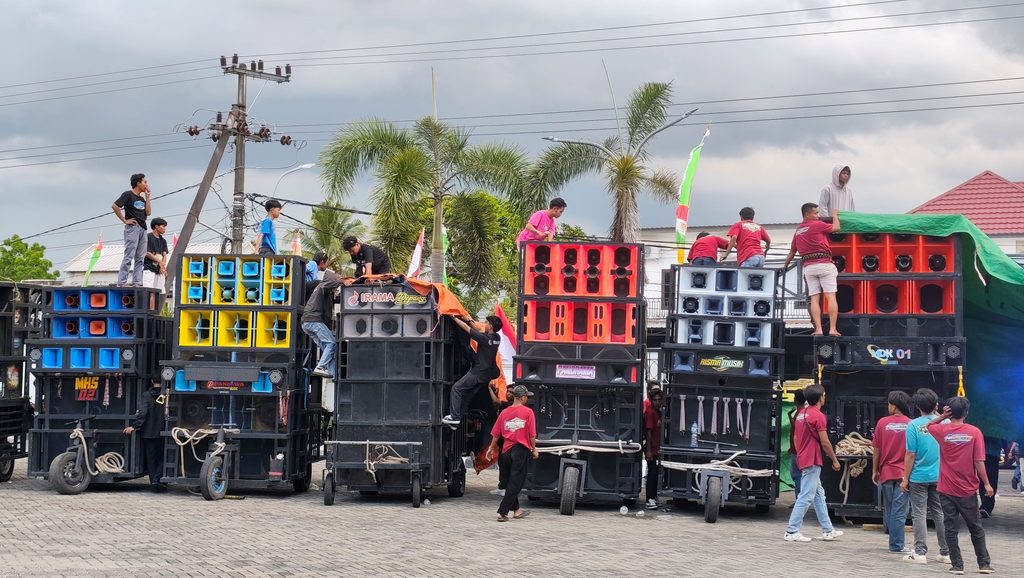
In recent decades, Kecimol, a modern musical ensemble featuring instruments such as guitars, bass and drums, has increasingly accompanied the procession. Its popularity has also changed the character of Nyongkolan, attracting younger participants and turning the procession into an increasingly lively public spectacle.
That transformation has sparked debate. Some traditional leaders have criticized modern Nyongkolan for traffic congestion, excessive celebration and behavior they believe no longer reflects Sasak customs. Others see these changes as part of how a living tradition evolves. Research on the debate found a form of compromise: Kecimol could be accepted, provided that participants maintained order, avoided alcohol and excessive eroticism, and continued to use symbols reflecting Sasak identity.
Perhaps this is what makes Nyongkolan fascinating. It is not simply a tradition preserved unchanged from the past. It is also a living conversation about marriage, community, identity and what it means to carry culture into the present.